

Every educational facility has spaces that must perform across multiple functions; a school auditorium that hosts prize-giving one week and a theatrical production the next or a university lecture hall that sees back-to-back seminars each day. When those spaces are fitted with the wrong seating, the issues go beyond discomfort.
Poor seating undermines engagement. Research from the Design Council found that the physical environment directly influences student behaviour and concentration (Higgins et al., 2005, commissioned by the Design Council). Uncomfortable or poorly arranged seating is a distraction, and in educational settings, distraction has real consequences.
Fixed seating in education, when designed and installed properly, eliminates these variables. It creates a defined, predictable environment that lets students, staff, and visitors focus on what matters most.
The Core Advantages of Fixed Seating in Education
- Structural Permanence and Safety
Fixed seating systems are bolted directly to the floor and, in some cases, the rear riser of tiered seating. This means there is no risk of chairs shifting, tipping, or collapsing under load, which is a critical consideration in environments where children and young people are present.
The UK's BS EN 13200 standard sets out requirements for spectator seating, and fixed installations are far easier to certify to these standards than portable alternatives.
Hussey Seatway's fixed seating range is engineered to meet these compliance requirements as standard, giving facilities managers and Bursar teams the confidence they need.
- Consistent Sightlines and Audience Experience
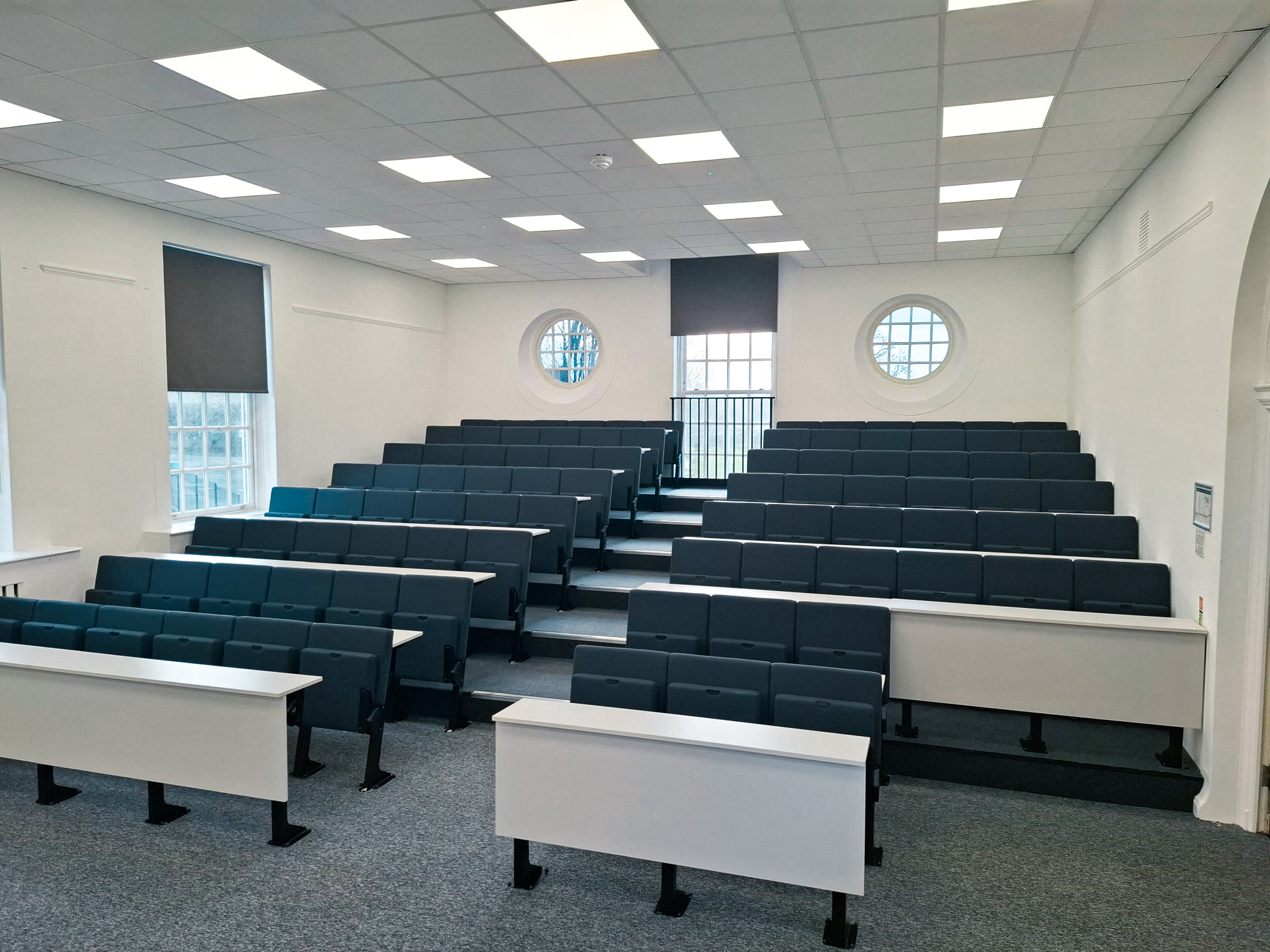
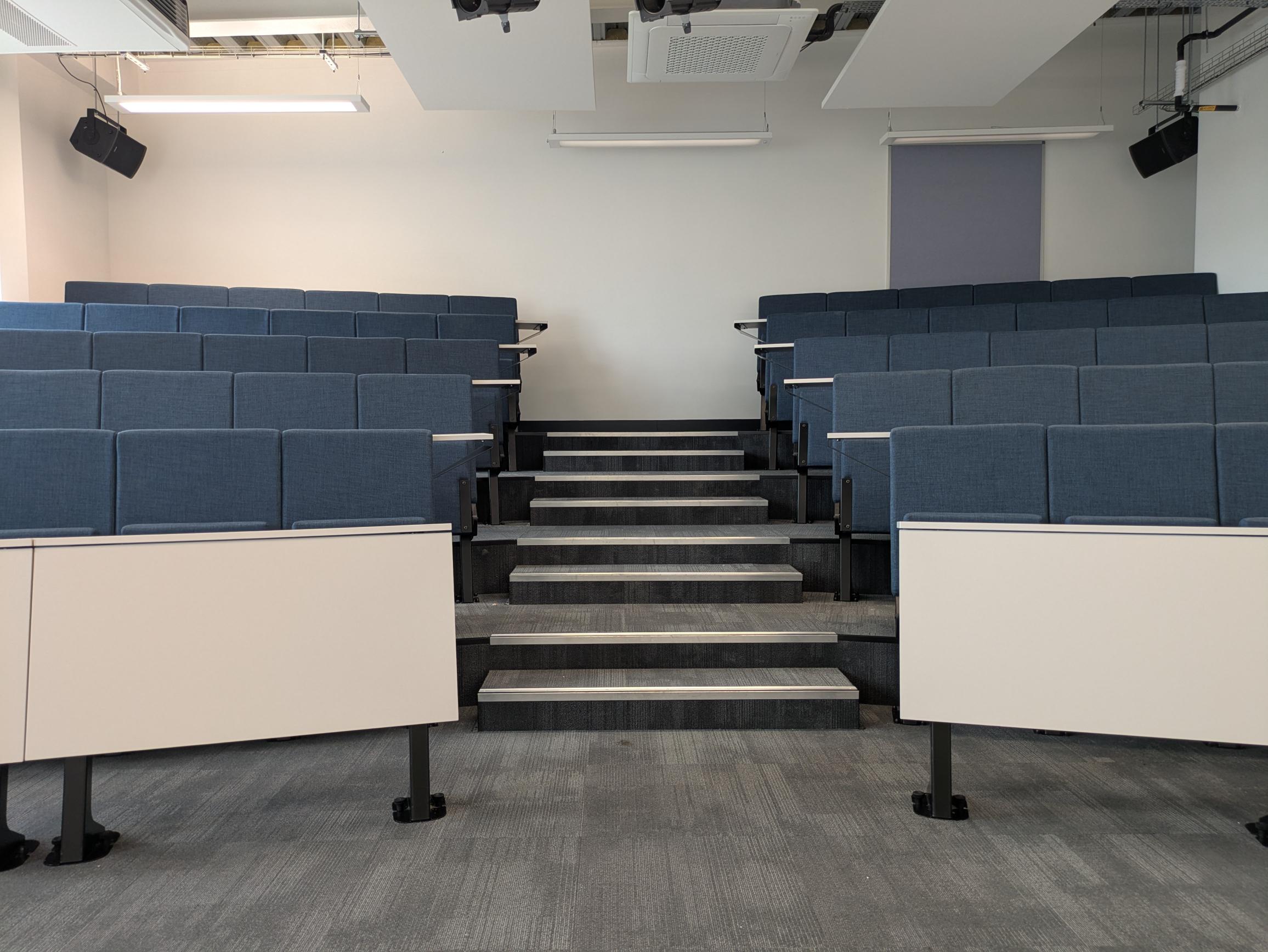
In lecture theatres, school auditoriums, and tiered assembly halls, every seat should offer an unobstructed view of the front. Fixed seating, installed on stepped or raked flooring, guarantees this. The physical design of a learning space has a measurable effect on how well students can engage with what is in front of them, and fixed seating, by holding row configuration permanently, removes one of the most common sources of degraded sightlines in busy educational venues.
Where portable chairs allow rows to shift and sightlines to degrade over time, fixed lecture hall seating holds its configuration permanently.
- Comfort Over Extended Periods
Educational settings often require students to remain seated for one to three hours at a time, whether in a lecture, a performance, or an exam. Fixed auditorium seating is purpose-designed for this. Many models in the Hussey Seatway range, including the Gallery 3 and the S200 LTF, feature upholstered seats with contoured backs, fold-up mechanisms, and optional writing tablets for lecture use.
This contrasts sharply with the plastic stacking chairs that too many schools still rely on for assembly which are functional, but not designed for sustained seated use.
- Reduced Maintenance and Lower Whole-Life Cost
One of the most compelling arguments for fixed seating in educational facilities is the total cost of ownership. While the upfront installation cost exceeds that of stackable chairs, fixed systems require significantly less ongoing maintenance. There are no legs to replace, no damage from repeated stacking and unstacking, and no wear from being dragged across floors.
Hussey Seatway offers a comprehensive service and maintenance programme, as well as a refurbishment and upgrades service that can extend the life of installed seating by decades. When you calculate cost per seat per year over a 20-year period, fixed seating routinely outperforms cheaper alternatives.
- Aesthetic Consistency and School Identity
School and university environments benefit from considered design. A fixed auditorium or lecture hall is often used for events that leave lasting impressions; graduation ceremonies, open days, and visiting speakers. Fixed seating, available in a wide range of upholstery colours and finishes, allows institutions to reinforce their identity and create spaces they are proud to show to prospective students, parents, and governors.
Hussey Seatway works closely with specifiers, architects, and end users to ensure that each installation aligns with the institution's aesthetic vision. With options from the S200 to the Gallery 3 and the Fixed Bench, the range accommodates everything from upholstered or polymer designs to contemporary, minimal styles.
- Compliance with Accessibility Requirements
The Equality Act 2010 requires educational facilities to make reasonable adjustments to accommodate disabled students and visitors. Fixed seating installations can be designed to incorporate designated wheelchair spaces, and accessible aisles as an integral part of the layout, not as an afterthought.
According to the Building Regulations Approved Document M, seating areas in educational buildings must include provision for wheelchair users at a ratio of not less than 1 in 100, with companion seating alongside (HM Government, Approved Document M, 2015).
Fixed seating makes it straightforward to build these requirements into the original specification, rather than attempting to retrofit compliance later.
Frequently Asked Questions
What Types of Educational Spaces Benefit Most?
Fixed seating in education is most commonly specified for:
- School classrooms and theatres spaces, where students gather daily for structured programmes
- Fixed lecture hall seating in colleges and universities, where back-to-back teaching demands durability and comfort
- Performing arts and drama spaces that double as presentation venues
- Sports and community facilities on school of university campuses
What is the difference between fixed seating and retractable seating in education?
Fixed seating is permanently installed and bolted to the floor. It offers the most robust, low-maintenance solution for spaces with a defined primary function such as a dedicated lecture theatre or assembly hall.
Retractable seating is foldable and can be stowed away to free up floor space, making it better suited for multipurpose halls that need to switch quickly between configurations. If your space has a single primary use, fixed seating is typically more cost-effective over the long term.
How long does fixed auditorium seating typically last in a school environment?
Well-specified fixed auditorium seating from a reputable manufacturer can last 20 to 30 years or more with appropriate maintenance. Hussey Seatway offers a dedicated service and maintenance programme to support the longevity of installed seating and a refurbishment service to refresh upholstery and components without the cost of full replacement.
Can fixed seating be customised for a school's colours or branding?
Yes. Hussey Seatway offers a wide range of upholstery fabrics, colours, and finishes across its fixed seating range. Educational institutions can specify seating that reflects their brand colours, coordinate with existing interior schemes, or choose from standard options that suit a variety of environments.
Does fixed lecture hall seating meet UK building regulations?
Hussey Seatway's fixed seating products are designed and tested to meet UK and international safety standards including BS EN 13200. All installations should be carried out by qualified contractors and signed off in line with the relevant building regulations, including Approved Document M for accessibility.
If you are planning a new build, refurbishment, or simply reviewing your existing seating provision, our team is ready to help. Hussey Seatway works with schools, colleges, universities, and their appointed consultants and specifiers to identify the right fixed seating solution for every project, whatever the size, budget, or design brief. Contact us today.